



Payment schedules: what is owed and when
A schedule is your plan for the money. A deposit now and a balance later, or one payment up front. It is a promise, not cash received.
The payment schedule answers one question: what does this customer owe, and by when?
It is a plan, not money. A schedule row saying 124.00 EUR due on 16 August does not mean anyone has paid. It means you expect to be paid by then.
Where it comes from
Most schedules build themselves. When a booking is confirmed, Voyant applies your payment policy and writes the rows.
A policy of "25 percent deposit, balance 30 days before travel" produces two rows automatically. See Set a customer payment policy.
Add a row by hand
Click Add schedule when a booking needs different terms, for example a customer who asked to pay in three instalments.
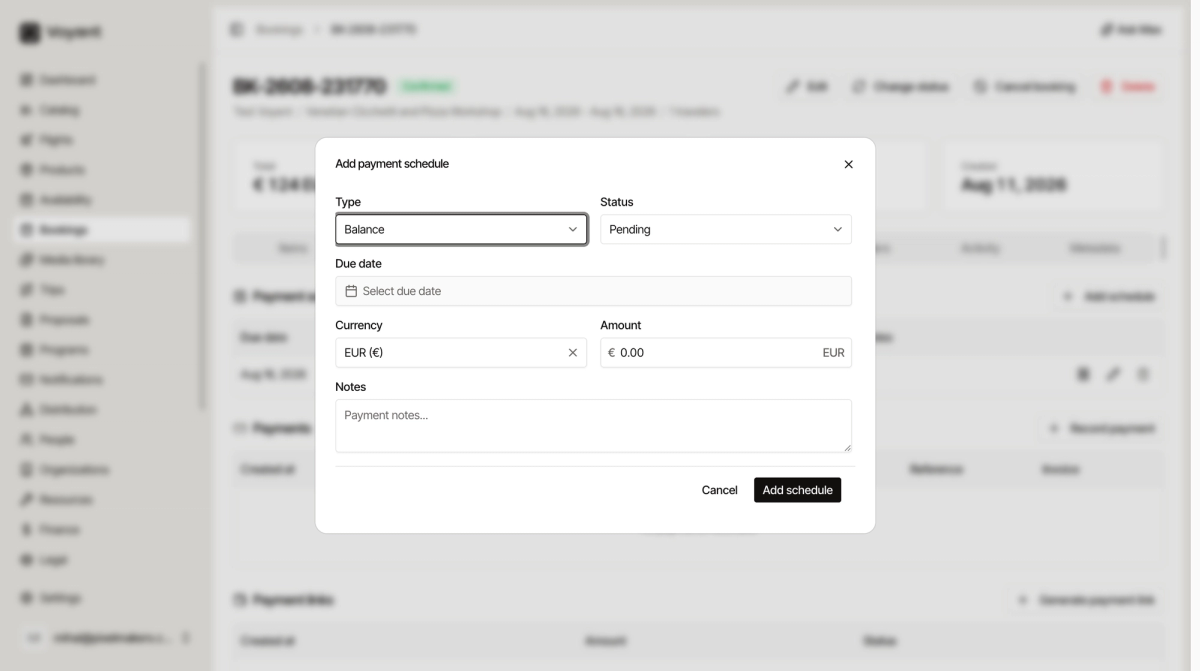
The five types
- Deposit is the first payment that secures the booking.
- Installment is one of several staged payments.
- Balance is the rest, usually due before travel.
- Hold covers money held against something rather than collected, such as a damage deposit.
- Other is anything that does not fit.
The six statuses
- Pending means not due yet.
- Due means the date has arrived and you are waiting.
- Paid means the money came in.
- Waived means you decided not to collect it. Use this rather than deleting, so the record shows a decision was made.
- Cancelled means the row no longer applies, for example after the booking changed.
- Expired means the window passed without payment.
A worked example
A 1,200 EUR trip, 25 percent deposit, balance a month before departure.
- Row one: Deposit, 300.00 EUR, due on the booking date.
- Row two: Balance, 900.00 EUR, due a month before travel.
As each is paid, its status becomes Paid and the Paid card at the top of the booking climbs towards 100 percent.
Did this answer your question?
Thanks for your feedback.