



Supplier invoices
The bills your suppliers send you, and how their cost gets attributed to the trips that incurred it.
Customer invoices are money in. Supplier invoices are money out: the bills from transport companies, guides, hotels and everybody else who delivered the trip.
Click Finance, then Supplier invoices.
Record one
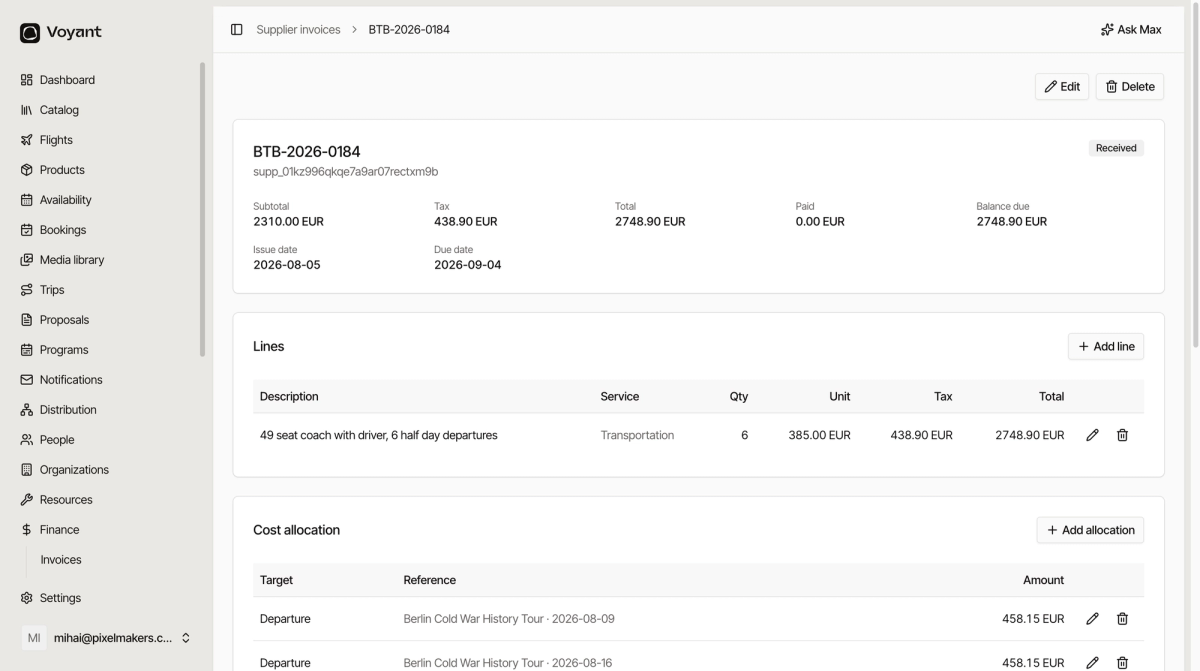
Click Record supplier invoice when a bill arrives. Fill in the invoice number, the supplier, the status, the currency, and the issue and due dates.
Then add the Lines, which is what you were charged for. Each line takes a description, a Cost category of Transportation, Accommodation, Guides and touristic services or Other, a quantity, a unit amount and tax.
Cost allocations
The point of recording them is not just paying on time. It is attributing the cost to the departures that caused it.
A coach company billing you monthly for six departures is one invoice covering six trips. Splitting that cost across them is what makes your margin figures real.
Getting the remainder to zero
Click Add allocation, choose a Target of Departure, Product, Booking or Traveler, enter the amount, and pick what it belongs to.
The Unattributed remainder at the bottom counts down as you go. Zero means every euro on the bill has found a home.
Why it matters
Until supplier invoices are recorded and allocated, your Actual cost stays at zero and every departure looks like 100 percent margin.
That is not profit, it is a gap in the data. See Profitability.
Planned against actual
The cost prices on your products are what you expected to pay. Supplier invoices are what you were actually charged. The difference is the variance, and watching it is how you find out a supplier has quietly raised their rates.
Did this answer your question?
Thanks for your feedback.